AI Systematic Review SoftwareMonths of literature review, compressed into days, with every decision auditable.
Explainable AI for the life sciences that turns months of manual literature review into days, with audit-grade provenance every step of the way.
Puraite delivers a draft systematic review in roughly <1 Month instead of the industry-standard 16 months, while maintaining screening accuracy above 90% against gold-standard datasets.
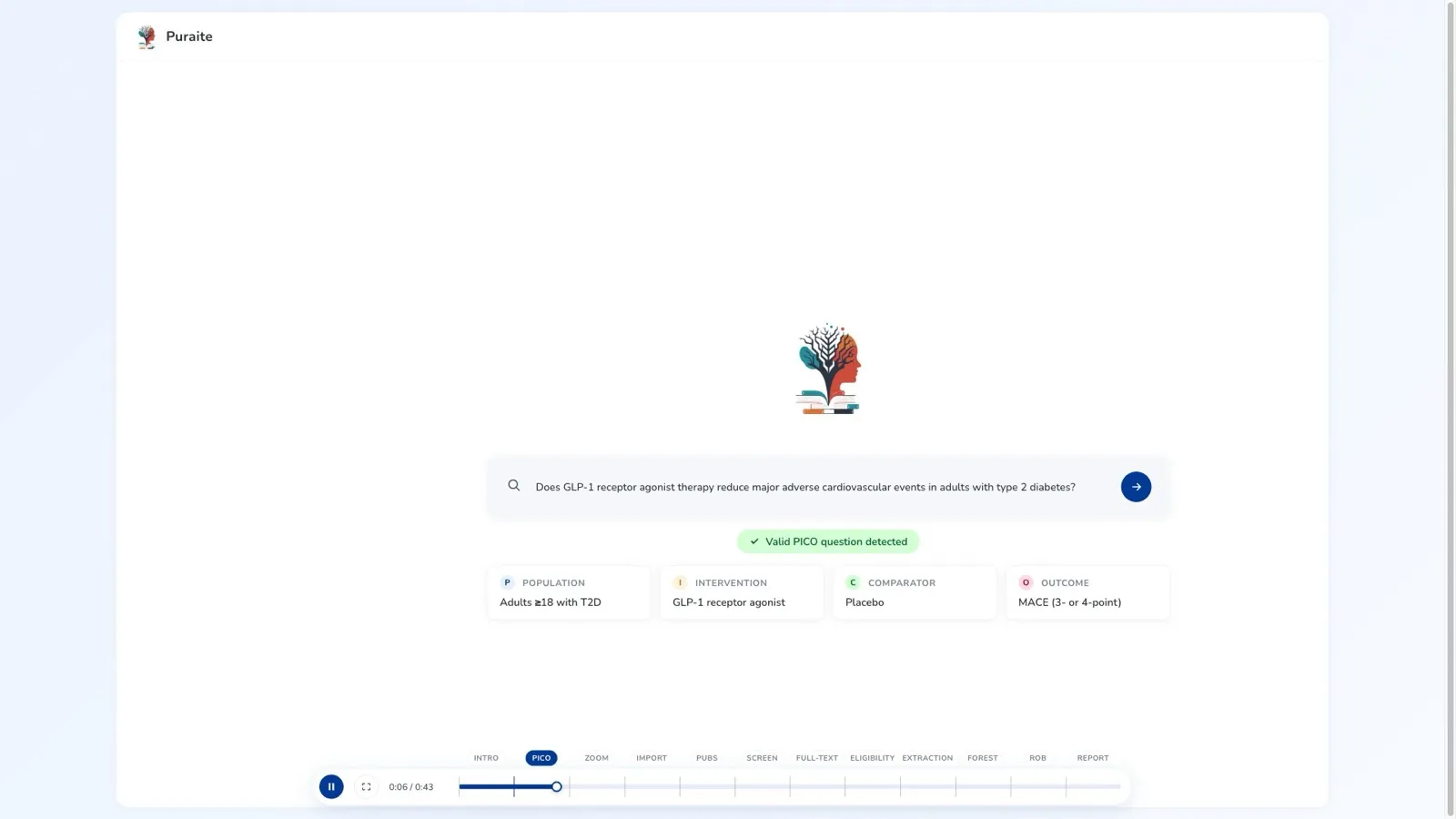
Puraite Workflow at a Glance
Watch the Puraite Platform in Action
Frequently Asked Questions
Puraite is an AI-powered platform for systematic literature reviews that combines scientific rigor with explainable AI (XAI) to deliver transparent, reproducible and regulatory-compliant results.
A systematic literature review (SLR) is a structured research methodology for identifying, appraising and synthesizing all relevant evidence on a specific research question. It follows predefined protocols to minimize bias and ensure comprehensiveness.
Puraite serves pharmaceutical companies, contract research organizations (CROs), health technology assessment (HTA) bodies, academic researchers and anyone conducting evidence synthesis in regulated environments.
Puraite achieves 95%+ screening accuracy with full transparency into every AI decision. The platform is PRISMA compliant, offers citation-level provenance and provides supercomputer-level processing for large-scale reviews.
Yes. Puraite is built on peer-reviewed methods and maintained through active university research partnerships. Our algorithms are validated against gold-standard systematic review datasets. The first publications with medical researchers are currently underway and will be published in 2026.
AI augments human reviewers by automating screening, extraction and synthesis tasks. Every AI decision is reviewable and overridable. Human experts maintain full control with approve, override, comment and second review capabilities.
Systematic reviews, scoping reviews, rapid reviews, living reviews, umbrella reviews, targeted reviews and meta-analyses. The platform adapts its workflow to each review type's specific methodology requirements.
Puraite is fully GDPR compliant with EU-based servers. All data is encrypted in transit and at rest. We implement strict access controls and regular security audits. We are currently pursuing ISO 27001 and SOC 2 certifications to meet the highest enterprise security standards.
Word (DOCX), CSV, PDF, RIS, XML, JSON and PRISMA-compliant reports. Export formats are compatible with major reference managers and regulatory submission requirements.
Depending on the scope and complexity, Puraite can reduce a typical 6-24 month systematic review to days or weeks. The exact timeline depends on the number of records, review type and level of human oversight required.
As of now, Puraite integrates with PubMed and OpenAlex. Embase, Medline and other major bibliographic databases are coming soon. Depending on the field, we also plan to support specialized niche databases for targeted evidence synthesis.
Yes. Puraite supports multi-reviewer projects with PM/reviewer roles, task assignment, conflict resolution, audit trails and real-time collaboration features. Advanced workspace analytics and richer consensus tooling are on the roadmap.
Puraite can automatically retrieve full-text PDFs from linked institutional subscriptions and open-access repositories. For paywalled content, the platform integrates with your institution's library access.
Puraite is designed to be intuitive for researchers familiar with systematic review methodology. We provide onboarding sessions, video tutorials and dedicated customer success support for all enterprise accounts.
The vast majority of biomedical evidence is published in English, which Puraite handles natively. Multi-language screening and extraction capabilities for major European and Asian languages are on our development roadmap and will be available in a future release.
Research groups working with Puraite
- IndiaAll India Institute of Speech and Hearing, MysuruSaransh Jain and its research team
- United StatesHarvard UniversityDepartment of Psychology
- IndonesiaNational Research and Innovation Agency (BRIN)
- ColombiaUniversidad de AntioquiaEscuela de Microbiología
- ItalyUniversità degli Studi della Campania Luigi Vanvitelli
- United KingdomUniversity of OxfordBrain Informatics Group
- IndiaAll India Institute of Speech and Hearing, MysuruSaransh Jain and its research team
- United StatesHarvard UniversityDepartment of Psychology
- IndonesiaNational Research and Innovation Agency (BRIN)
- ColombiaUniversidad de AntioquiaEscuela de Microbiología
- ItalyUniversità degli Studi della Campania Luigi Vanvitelli
- United KingdomUniversity of OxfordBrain Informatics Group
- IndiaAll India Institute of Speech and Hearing, MysuruSaransh Jain and its research team
- United StatesHarvard UniversityDepartment of Psychology
- IndonesiaNational Research and Innovation Agency (BRIN)
- ColombiaUniversidad de AntioquiaEscuela de Microbiología
- ItalyUniversità degli Studi della Campania Luigi Vanvitelli
- United KingdomUniversity of OxfordBrain Informatics Group
- IndiaAll India Institute of Speech and Hearing, MysuruSaransh Jain and its research team
- United StatesHarvard UniversityDepartment of Psychology
- IndonesiaNational Research and Innovation Agency (BRIN)
- ColombiaUniversidad de AntioquiaEscuela de Microbiología
- ItalyUniversità degli Studi della Campania Luigi Vanvitelli
- United KingdomUniversity of OxfordBrain Informatics Group
- IndiaAll India Institute of Speech and Hearing, MysuruSaransh Jain and its research team
- United StatesHarvard UniversityDepartment of Psychology
- IndonesiaNational Research and Innovation Agency (BRIN)
- ColombiaUniversidad de AntioquiaEscuela de Microbiología
- ItalyUniversità degli Studi della Campania Luigi Vanvitelli
- United KingdomUniversity of OxfordBrain Informatics Group
- IndiaAll India Institute of Speech and Hearing, MysuruSaransh Jain and its research team
- United StatesHarvard UniversityDepartment of Psychology
- IndonesiaNational Research and Innovation Agency (BRIN)
- ColombiaUniversidad de AntioquiaEscuela de Microbiología
- ItalyUniversità degli Studi della Campania Luigi Vanvitelli
- United KingdomUniversity of OxfordBrain Informatics Group
Puraite's end-to-end systematic review platform has allowed us to maintain a high level of research momentum without compromising human control. It has streamlined our evidence synthesis workflow, allowing our team to process and manage over 10,000 records in an auditable, highly efficient workspace.
Dan Radford-Smith and Daniel KorPostdoctoral Researchers, Brain Informatics Group, University of Oxford We use Puraite to streamline our systematic reviews, particularly for collaborative screening, risk-of-bias assessment, and data extraction. The platform has helped our team organize the review workflow more efficiently and maintain consistency across the stages of the review.
Saransh Jain, PhDAssistant Professor of Audiology, All India Institute of Speech and Hearing, Mysuru Puraite has helped our research team streamline the full-text retrieval process for our systematic review. This has been valuable in supporting an efficient and systematic approach to evidence synthesis.
Ina Kusrini, SKM, MKMResearcher, National Research and Innovation Agency (BRIN), Indonesia We have used Puraite to support the screening workflow of our systematic review, from title and abstract screening through to full-text assessment. The platform has helped us keep the process structured, efficient and transparent, while remaining very intuitive to use.
Marco Fiore, MD, MScResearcher in Anesthesiology and Intensive Care, Università degli Studi della Campania Luigi Vanvitelli Puraite has been a very helpful tool in our research.
Juan Pablo Bermudez CorralesUndergraduate student, Microbiology and Bioanalysis, Escuela de Microbiología, Universidad de Antioquia Puraite's end-to-end systematic review platform has allowed us to maintain a high level of research momentum without compromising human control. It has streamlined our evidence synthesis workflow, allowing our team to process and manage over 10,000 records in an auditable, highly efficient workspace.
Dan Radford-Smith and Daniel KorPostdoctoral Researchers, Brain Informatics Group, University of Oxford We use Puraite to streamline our systematic reviews, particularly for collaborative screening, risk-of-bias assessment, and data extraction. The platform has helped our team organize the review workflow more efficiently and maintain consistency across the stages of the review.
Saransh Jain, PhDAssistant Professor of Audiology, All India Institute of Speech and Hearing, Mysuru Puraite has helped our research team streamline the full-text retrieval process for our systematic review. This has been valuable in supporting an efficient and systematic approach to evidence synthesis.
Ina Kusrini, SKM, MKMResearcher, National Research and Innovation Agency (BRIN), Indonesia We have used Puraite to support the screening workflow of our systematic review, from title and abstract screening through to full-text assessment. The platform has helped us keep the process structured, efficient and transparent, while remaining very intuitive to use.
Marco Fiore, MD, MScResearcher in Anesthesiology and Intensive Care, Università degli Studi della Campania Luigi Vanvitelli Puraite has been a very helpful tool in our research.
Juan Pablo Bermudez CorralesUndergraduate student, Microbiology and Bioanalysis, Escuela de Microbiología, Universidad de Antioquia
Puraite's end-to-end systematic review platform has allowed us to maintain a high level of research momentum without compromising human control. It has streamlined our evidence synthesis workflow, allowing our team to process and manage over 10,000 records in an auditable, highly efficient workspace.
Dan Radford-Smith and Daniel KorPostdoctoral Researchers, Brain Informatics Group, University of Oxford We use Puraite to streamline our systematic reviews, particularly for collaborative screening, risk-of-bias assessment, and data extraction. The platform has helped our team organize the review workflow more efficiently and maintain consistency across the stages of the review.
Saransh Jain, PhDAssistant Professor of Audiology, All India Institute of Speech and Hearing, Mysuru Puraite has helped our research team streamline the full-text retrieval process for our systematic review. This has been valuable in supporting an efficient and systematic approach to evidence synthesis.
Ina Kusrini, SKM, MKMResearcher, National Research and Innovation Agency (BRIN), Indonesia We have used Puraite to support the screening workflow of our systematic review, from title and abstract screening through to full-text assessment. The platform has helped us keep the process structured, efficient and transparent, while remaining very intuitive to use.
Marco Fiore, MD, MScResearcher in Anesthesiology and Intensive Care, Università degli Studi della Campania Luigi Vanvitelli Puraite has been a very helpful tool in our research.
Juan Pablo Bermudez CorralesUndergraduate student, Microbiology and Bioanalysis, Escuela de Microbiología, Universidad de Antioquia Puraite's end-to-end systematic review platform has allowed us to maintain a high level of research momentum without compromising human control. It has streamlined our evidence synthesis workflow, allowing our team to process and manage over 10,000 records in an auditable, highly efficient workspace.
Dan Radford-Smith and Daniel KorPostdoctoral Researchers, Brain Informatics Group, University of Oxford We use Puraite to streamline our systematic reviews, particularly for collaborative screening, risk-of-bias assessment, and data extraction. The platform has helped our team organize the review workflow more efficiently and maintain consistency across the stages of the review.
Saransh Jain, PhDAssistant Professor of Audiology, All India Institute of Speech and Hearing, Mysuru Puraite has helped our research team streamline the full-text retrieval process for our systematic review. This has been valuable in supporting an efficient and systematic approach to evidence synthesis.
Ina Kusrini, SKM, MKMResearcher, National Research and Innovation Agency (BRIN), Indonesia We have used Puraite to support the screening workflow of our systematic review, from title and abstract screening through to full-text assessment. The platform has helped us keep the process structured, efficient and transparent, while remaining very intuitive to use.
Marco Fiore, MD, MScResearcher in Anesthesiology and Intensive Care, Università degli Studi della Campania Luigi Vanvitelli Puraite has been a very helpful tool in our research.
Juan Pablo Bermudez CorralesUndergraduate student, Microbiology and Bioanalysis, Escuela de Microbiología, Universidad de Antioquia
Puraite's end-to-end systematic review platform has allowed us to maintain a high level of research momentum without compromising human control. It has streamlined our evidence synthesis workflow, allowing our team to process and manage over 10,000 records in an auditable, highly efficient workspace.
Dan Radford-Smith and Daniel KorPostdoctoral Researchers, Brain Informatics Group, University of Oxford We use Puraite to streamline our systematic reviews, particularly for collaborative screening, risk-of-bias assessment, and data extraction. The platform has helped our team organize the review workflow more efficiently and maintain consistency across the stages of the review.
Saransh Jain, PhDAssistant Professor of Audiology, All India Institute of Speech and Hearing, Mysuru Puraite has helped our research team streamline the full-text retrieval process for our systematic review. This has been valuable in supporting an efficient and systematic approach to evidence synthesis.
Ina Kusrini, SKM, MKMResearcher, National Research and Innovation Agency (BRIN), Indonesia We have used Puraite to support the screening workflow of our systematic review, from title and abstract screening through to full-text assessment. The platform has helped us keep the process structured, efficient and transparent, while remaining very intuitive to use.
Marco Fiore, MD, MScResearcher in Anesthesiology and Intensive Care, Università degli Studi della Campania Luigi Vanvitelli Puraite has been a very helpful tool in our research.
Juan Pablo Bermudez CorralesUndergraduate student, Microbiology and Bioanalysis, Escuela de Microbiología, Universidad de Antioquia Puraite's end-to-end systematic review platform has allowed us to maintain a high level of research momentum without compromising human control. It has streamlined our evidence synthesis workflow, allowing our team to process and manage over 10,000 records in an auditable, highly efficient workspace.
Dan Radford-Smith and Daniel KorPostdoctoral Researchers, Brain Informatics Group, University of Oxford We use Puraite to streamline our systematic reviews, particularly for collaborative screening, risk-of-bias assessment, and data extraction. The platform has helped our team organize the review workflow more efficiently and maintain consistency across the stages of the review.
Saransh Jain, PhDAssistant Professor of Audiology, All India Institute of Speech and Hearing, Mysuru Puraite has helped our research team streamline the full-text retrieval process for our systematic review. This has been valuable in supporting an efficient and systematic approach to evidence synthesis.
Ina Kusrini, SKM, MKMResearcher, National Research and Innovation Agency (BRIN), Indonesia We have used Puraite to support the screening workflow of our systematic review, from title and abstract screening through to full-text assessment. The platform has helped us keep the process structured, efficient and transparent, while remaining very intuitive to use.
Marco Fiore, MD, MScResearcher in Anesthesiology and Intensive Care, Università degli Studi della Campania Luigi Vanvitelli Puraite has been a very helpful tool in our research.
Juan Pablo Bermudez CorralesUndergraduate student, Microbiology and Bioanalysis, Escuela de Microbiología, Universidad de Antioquia
From Protocol to Evidence in Six Phases
The complete systematic review workflow, powered by explainable AI.
Phase 1: Planning & Protocol
The most critical phase of any systematic review. If the protocol leaves room for interpretation, downstream AI and human decisions will be inconsistent. Puraite provides a guided wizard that walks you step by step through protocol creation – simply fill in the fields without having to set up the protocol manually. It flags ambiguous criteria in real time so every inclusion rule is precise before screening begins.
Three Ways to Run Your Review
Puraite runs systematic reviews your way: manual, hybrid or AI-assisted, with team workflows built in.
AI-Driven
For teams that want speed.
Use AI to draft searches, screen studies, extract data, flag conflicts and prepare outputs. Human reviewers stay in control with approve, override and audit trails.
Hybrid
For CROs and HEOR teams.
Assign reviewers, split workloads, use AI where it helps, and keep manual checks for high-stakes decisions. Built-in conflict resolution keeps the team moving.
Fully Manual
For Cochrane-style or conservative workflows.
Run the entire SLR manually: reviewer assignment, dual screening, extraction, comments, conflicts, audit trail and project oversight, with AI turned off or used only when approved.
Built For Review Teams
Roles, assignments, audit trail. Your team migrates cleanly into Puraite.
Project Manager
Configure protocol, assign reviewers, monitor progress, resolve bottlenecks.
Reviewer
Screen, extract, comment and resolve conflicts in assigned workspaces.
Viewer / Stakeholder
Follow progress and inspect outputs without changing study decisions.
Audit Trail
Decisions, overrides, comments and AI-assisted actions are attributable by user.
Who Puraite Is Made For
Regulated industries where the speed, auditability, and reproducibility of evidence synthesis directly determine commercial and regulatory outcomes.
Free for Academia
Puraite is available at no cost for university researchers and non-commercial systematic review teams. Rigorous evidence synthesis should not be gated by budget.
Academic accounts come with limited monthly usage. For high-volume research groups, tailored plans are available on request.
We actively welcome research collaborations with academic teams. If you are planning a systematic review and would like to validate Puraite against gold-standard datasets as part of a peer-reviewed publication, we provide extended access, methodological support and co-authorship where appropriate. Reach out with your research question and we will discuss how to support your work.
Where Do You Stand on SLR Automation?
See how AI-powered evidence synthesis compares to your current workflow.
Industry benchmark: a standard systematic review with 5 co-authors over 16 months costs approximately €165,000 in researcher time. Costs scale proportionally with team size and project duration.
Why Puraite
Four capabilities that set Puraite apart from generic AI tools and legacy SLR platforms.
Every decision, traced to source.
Every AI screening decision links directly to the sentence that drove it, with a calibrated confidence score. No black box. No trust-us outputs. Auditable at every step.
Built for submission, not just discovery.
PRISMA flow diagrams, GRADE certainty ratings and RoB assessments are generated automatically with complete decision logs, ready for HTA, MDR CER or FDA dossier.
You decide. AI recommends.
Approve, override, comment or escalate any AI action at any stage. Puraite augments your team's judgment; it never replaces it. All overrides are logged and exportable.
One digital workspace. Zero media breaks.
Protocol to PRISMA report, every step lives inside one auditable environment. No switching tools, no copy-paste. Activate AI at any step or work entirely manually.
Built for Regulated Environments
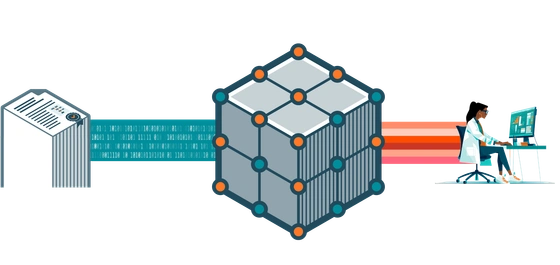
Every AI decision is transparent, traceable and auditable.
Citation-Level Provenance
Every output traced to its source passage
Confidence Scoring
Calibrated 1–100% certainty on every decision
Complete Audit Trails
Full decision logs for regulatory review
Human Control Plane
Approve, override or escalate any AI decision
Zero Data Retention
Your data is never stored on or used to train AI models. All data can be purged on demand.
Engineering Rigor
How we build, validate and deploy AI for regulated evidence synthesis.
Validated against gold-standard evidence
Every AI module is benchmarked against expert-curated systematic review datasets. Screening decisions are validated against Cochrane-quality inclusion sets. We measure recall, precision and calibration continuously, not just at launch. Joint publications with independent academic researchers are underway and scheduled for publication in Q3/Q4 2026.
Selecting the right model for each task
We benchmark leading foundation models across every pipeline stage: retrieval, screening, extraction and synthesis. Model selection is task-specific. A model that excels at eligibility classification may underperform at data extraction. We fine-tune and specialize models for domain-specific tasks such as HEOR dossier preparation, clinical data extraction and regulatory evidence appraisal. This allows us to deploy the most capable model for each step at the lowest cost and energy consumption.
Calibrated confidence, not black-box predictions
Our screening engine uses conformal prediction to deliver statistically guaranteed coverage rates. Every decision includes a confidence score with known error bounds. When the AI is uncertain, it flags the record for human review instead of guessing.
Integrates with Your Research Stack
Connect to major biomedical databases and export to the formats your team already uses.
Additional databases coming soon.
What's Coming Next
Puraite is building toward a fully autonomous, continuously learning evidence platform. Here's what's on the horizon.
Multi-Reviewer Workflows
PM/reviewer roles, task assignment, conflict resolution, audit trail and manual/hybrid/AI-assisted screening and extraction. Ready for distributed teams today.
Living Evidence Platform
Systematic reviews that update automatically as new literature publishes. No re-runs, no re-screening; your evidence base stays current.
Shapley Attribution
Know exactly which studies drove every meta-analytic conclusion. Game-theoretic attribution surfaces the evidence that matters most, and why.
Advanced Evidence Studio
Richer team dashboards, real-time consensus workspace, deeper annotation workflows and workload analytics for multi-site trials.
Want early access to upcoming features?
Talk to the Team